
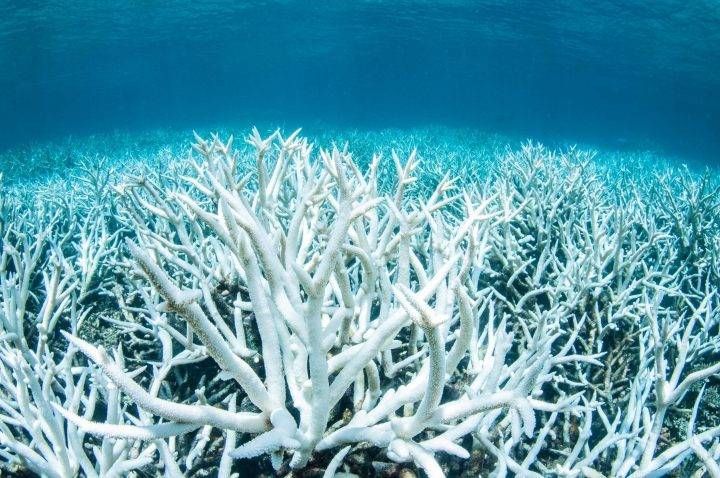
The Great Barrier Reef’s “Dawning” Crisis: A Technical Post-Mortem of 2025/26
The Australian Institute of Marine Science (AIMS) and the Great Barrier Reef Marine Park Authority (Reef Authority) have released their most volatile health assessment in four decades. The 2025/26 Dawning Report (officially the AIMS Long-Term Monitoring Summary) confirms that the Reef has suffered its sharpest annual decline in coral cover since records began in 1986.
While the Reef has historically cycled through periods of disturbance and recovery, the consecutive mass bleaching events of 2024 and 2025 mark a fundamental shift in ecosystem mechanics. We are no longer observing occasional “outages”; we are witnessing a systemic “down-scaling” of the world’s most significant biological asset.
Historical Evolution: From Resilience to Volatility
For thirty years, the Reef followed a predictable “Disturbance-Recovery” cycle. Large-scale events like Cyclone Hamish (2009) or the 2016/17 back-to-back bleaching were followed by decade-long windows of regrowth. Fast-growing Acropora corals (staghorn and tabletop) would rapidly recolonize the limestone skeletons, often leading to “historic highs” in coral cover as recently as 2022.
However, the 2025 data suggests this “weedy” recovery was a structural vulnerability. These fast-growing corals are the most susceptible to heat stress. By January 2026, the Northern and Southern sectors recorded their largest single-year losses in 39 years, proving that the recent “recovery” was a high-risk, low-resilience anomaly.
Technical Deep-Dive: The Mechanics of the 6th Event
The Reef’s thermal management system has failed. The 6th mass bleaching event since 2016 is being driven by three primary technical drivers:
- Thermal Overload (DHW): Degree Heating Weeks (DHW) began accumulating as early as November 2025. In the Far Northern region, Sea Surface Temperatures (SST) reached 29.8°C, nearly 2.0°C above the long-term baseline.
- Salinity Drop (Freshwater Inundation): Record rainfall in early 2025 created “Flood Plumes” that extended 110km offshore. This low-salinity water “bleached” inshore corals mechanically, even in areas where the water temperature was safe.
- COTS Outbreak Propagation: The “Swain Reefs” in the South are currently under siege by Crown-of-Thorns Starfish (COTS). These coral-eating predators move in waves; the current 2026 wave is categorized as one of the most severe in the Southern sector’s history.
Quantitative Data: The 2025/26 Snapshot
The following table illustrates the devastating regional “delta” between 2024 and early 2026.
| Region | 2024 Hard Coral Cover | 2026 Projected/Current Cover | Net Annual Change |
| Northern GBR | 39.8% | 30.0% | -24.8% |
| Central GBR | 33.2% | 28.6% | -14.0% |
| Southern GBR | 39.1% | 26.9% | -31.2% |
| Far Northern | Stable | Bleaching Alert Level 1 | Pending |
Global Macro-Economic & Geopolitical Implications
The Reef is no longer just an “environmental” story; it is a macro-economic titan. As of October 2025, the Reef’s total economic value was appraised at $95 Billion, a massive 69% increase from the 2017 valuation of $56B. It contributes $9 Billion annually to Australia’s GDP and supports 77,000 full-time jobs, effectively making it Australia’s 5th largest “employer.”
Geopolitically, the stakes culminated on January 30, 2026, when the Australian Government submitted its “State Party Report” to the UNESCO World Heritage Centre. This report is the final defense against the Reef being placed on the “In Danger” list. A listing would not just be a blow to national pride; it would likely trigger “negative-sentiment” divestment in Australia’s tourism sector and force a radical, and expensive, realignment of the national energy grid to meet UNESCO’s environmental mandates.
Forecasting: The 2035 Roadmap
As we look toward 2030-2035, predictive modeling from the Intergovernmental Panel on Climate Change (IPCC) and AIMS suggests that the “Recovery Period” between disturbances will continue to shrink.
If global temperatures stabilize at 1.5°C, we expect 70-90% of global corals to perish. However, a $124 Billion economic opportunity exists if we can successfully implement Reef Restoration and Adaptation Program (RRAP) initiatives. This includes:
- Heat-Tolerant Seeding: Using CRISPR-style gene editing to select for “super corals.”
- Cloud Brightening: Using salt-spray cannons to reflect sunlight and cool the water during peak summer months.
- AI-COTS Control: Subsurface autonomous drones to cull starfish outbreaks with 99% accuracy.
The “Dawning” of 2026 is a transition from an era of conservation (protecting what we have) to an era of intervention (engineering what we need). We have built an economic system on a biological foundation that can no longer scale to meet the heat stress of the 21st century.
Leave a Reply